Is ADHD a Learning Disorder? ADHD vs. Learning Disabilities
ADHD is a neurodevelopmental disorder that affects attention, impulse control, and executive functioning. Learning disabilities affect specific academic skills, such as reading, writing, or math. However, the two can occur together and create overlapping challenges.
This overlap can make it difficult to tell if challenges at school or work are related to attention, a specific learning disability, or both.
So, is ADHD a learning disorder? This article explains the key differences, how the conditions can occur together, and how a psychological evaluation can clarify the cause.
Is ADHD a learning disorder?

No, ADHD is not a learning disorder. The National Institute of Mental Health defines ADHD as a developmental disorder involving persistent symptoms of inattention, hyperactivity, impulsivity, or a combination of these symptoms.
ADHD can still affect learning. Difficulties with attention, working memory, organization, and follow-through may make it harder to absorb information, complete assignments, and demonstrate knowledge consistently.
ADHD vs. learning disabilities

ADHD and learning disabilities are separate conditions that affect performance differently. ADHD primarily affects attention and executive functioning, while learning disabilities affect specific academic skills.
| Area | ADHD | Learning disabilities |
|---|---|---|
| Type of condition | Neurodevelopmental disorder | Disorder affecting specific academic skills |
| Main difficulty | Attention, impulse control, and executive functioning | Reading, writing, math, or another academic skill |
| Common signs | Losing focus, forgetting instructions, and leaving work unfinished | Ongoing difficulty reading, spelling, writing, or using math |
| Effect on performance | Makes it harder to organize and show what a person knows | Makes it harder to develop or use a specific skill |
| Where it appears | Usually affects more than one setting | Most noticeable during tasks involving the affected skill |
| Evaluation focus | Attention, behavior, development, and executive functioning | Academic skills, learning history, and cognitive abilities |
The difference is not always clear from grades or performance alone. An unfinished reading assignment could reflect difficulty maintaining attention, difficulty reading, or both. The same applies to adults who struggle with written reports, instructions, or tasks involving calculations.
How does ADHD affect learning at school and work?
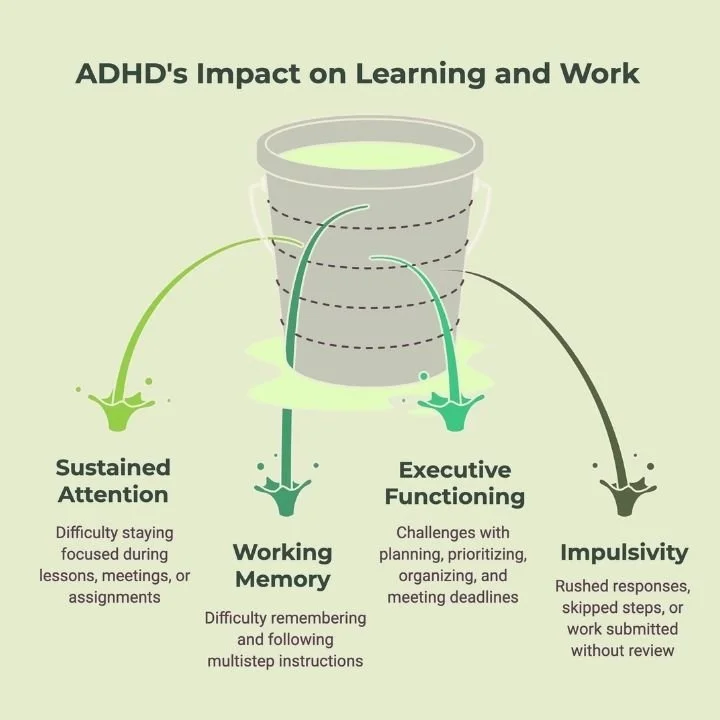
ADHD can affect learning at school and work by making it harder to maintain attention, remember instructions, organize responsibilities, and apply new information consistently.
ADHD can make sustained attention harder
Students may lose focus during lessons, reading, or assignments. At work, adults may find it difficult to follow meetings, complete training, or review detailed documents. Attention can also vary depending on a task’s interest, urgency, and level of stimulation. Learn more about attention span and ADHD.
Working memory can affect instructions
Working memory allows a person to hold information in mind while using it. A student may forget steps in an assignment, while an employee may lose track of verbal instructions, procedures, or client requests. This can make multistep tasks harder to complete accurately.
Executive functioning can disrupt responsibilities
Executive functioning supports planning, organization, time management, and task completion. Students may struggle to organize materials or meet assignment deadlines. Working adults may have difficulty prioritizing projects, managing schedules, or shifting between responsibilities.
Impulsivity can lead to avoidable errors
Impulsivity may cause students to rush through questions or submit work without reviewing it. Employees may respond before reading complete instructions, overlook required steps, or submit unfinished work. These errors do not necessarily reflect a lack of knowledge or ability.
When ADHD and learning disabilities occur together

ADHD and learning disabilities can occur together, making their effects difficult to separate without an evaluation. A research found that at least 25% of children with ADHD also have a learning disability.
When both conditions are present, a person may have difficulty managing attention and organization while also struggling with a specific skill, such as reading, writing, or math. These combined challenges can affect schoolwork, workplace training, and tasks involving written information or calculations.
Identifying both conditions matters because support for one may not address the other. Evaluation results can guide ADHD treatment, academic intervention, practical strategies, and appropriate accommodations.
Signs an ADHD or learning evaluation may be needed

An ADHD or learning evaluation may be helpful when difficulties with attention, organization, reading, writing, or math persist beyond occasional mistakes.
Signs may include:
Difficulty staying focused or following instructions
Frequently forgetting tasks, materials, or deadlines
Trouble organizing and completing responsibilities
Persistent difficulty with reading, writing, or math
Making repeated errors despite knowing the material
Taking longer than expected to finish tasks
Performance that does not reflect the person’s abilities
These signs do not confirm ADHD or a learning disability. A comprehensive evaluation can identify factors contributing to the difficulties and determine which forms of support may be appropriate.
How testing distinguishes ADHD from a learning disorder
Psychological testing distinguishes ADHD from a learning disorder by examining attention, academic skills, cognitive functioning, and daily performance. The clinician reviews patterns from several sources rather than relying on one symptom or test score.
What the evaluation measures
Depending on the concerns, an evaluation may assess:
Attention and concentration
Executive functioning
Working memory and processing speed
Reading, writing, and math skills
Learning and memory
Mood, anxiety, and behavior
Developmental and educational history
These findings can show if the difficulties relate to ADHD, a learning disorder, both conditions, or another concern.
How results guide accommodations, treatment, and support
The results provide a clear explanation of the findings and recommendations based on the person’s needs. These may include school or workplace accommodations, academic intervention, organizational strategies, treatment referrals, or additional support.
For students, recommendations may include an IEP or 504 plan. An IEP provides specialized instruction and related services, while a 504 plan provides accommodations that support access to learning.
Book psychologist-led ADHD and learning testing in Florida
Psychologist-led testing can determine if attention or learning difficulties are related to ADHD, a learning disability, both conditions, or another concern.
Verdant Psychology provides ADHD and learning evaluations adolescents and adults across Florida. Each evaluation includes clear findings, a detailed written report, and practical recommendations for school, work, treatment, or accommodations.
Book a free consultation to discuss your concerns and determine if testing is an appropriate next step.
Common questions about ADHD and learning disabilities
What counts as a learning disability?
A learning disability causes persistent difficulty developing or using specific academic skills, such as reading, written expression, or math, despite appropriate instruction and opportunities to learn.
What are five early warning signs of learning disabilities?
Five possible early signs are delayed speech, difficulty recognizing rhyming words, trouble matching letters with sounds, problems following directions, and recurring reading or spelling errors.
Is ADHD a disability or mental illness?
ADHD is a neurodevelopmental disorder. It may also qualify as a disability under educational or workplace laws when its symptoms substantially limit learning, working, or another major area of daily functioning.
Is anxiety a learning disability?
No, anxiety is not a learning disability. However, it can affect concentration, memory, classroom participation, and test performance, which may resemble or add to learning difficulties.
Can a child outgrow ADHD?
ADHD symptoms can change as a child matures, but the condition may continue through adolescence and adulthood. A child may develop stronger coping skills even if difficulties with attention, impulsivity, or executive functioning remain.