What Does An Autism Evaluation Involve From Intake to Results?
An autism evaluation involves reviewing developmental history, completing interviews and questionnaires, observing behavior, and using standardized measures. The process ends with a feedback session and written report explaining the findings and recommendations.
Not knowing what will happen during testing can make the first appointment feel harder to approach. You do not need to arrive with every detail organized or already know if autism is the correct explanation.
If you are asking what does an autism evaluation involve, the process is designed to examine patterns carefully rather than rely on one symptom or questionnaire. Here is what to expect when seeking autism testing in Florida.
The autism evaluation process step by step
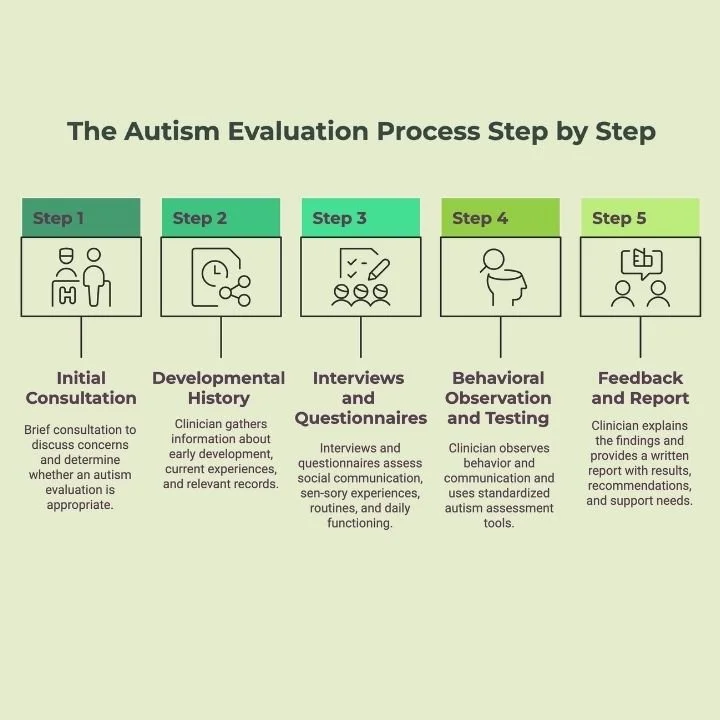
The autism evaluation process moves from an initial consultation through information gathering, testing, feedback, and a written report.
Step 1. Initial consultation and intake
During the free 15-minute consultation, you explain why you are seeking testing and describe signs of autism, such as communication differences, sensory sensitivities, repetitive behaviors, or difficulty with change. The clinician asks brief questions, determines if testing is appropriate, and explains the cost and schedule.
You then complete consent forms, background questionnaires, and practice policies before the first appointment.
Step 2. Developmental history and record review
The clinician asks about early communication, friendships, routines, sensory responses, education, work, relationships, and behavior. You may submit school records, medical records, previous evaluations, or treatment notes.
Family input can provide additional context, but adults without access to childhood records or relatives can still complete an evaluation.
Step 3. Interviews and questionnaires
You complete a detailed clinical interview and questionnaires about social communication, routines, interests, sensory experiences, and daily functioning.
Parents, teachers, or partners may complete separate rating forms. Their responses help the clinician compare patterns across settings and determine if the traits have been present since early development.
Step 4. Behavioral observation and standardized testing
The clinician observes how you communicate, respond to social cues, and approach activities. Testing may include the ADOS-2 (structured observation), ADI-R (developmental history interview), and SRS-2 (social behavior rating scale).
Research supports combining standardized tools, developmental history, observation, and clinical judgment.
Step 5. Feedback session and written report
During the feedback session, the clinician tells you if the findings support an autism diagnosis and explains the evidence behind the conclusion. You can ask questions and review recommendations.
You also receive a written report describing the tests, results, diagnosis, identified strengths, support needs, referrals, and possible accommodations.
What clinicians assess during autism testing

Clinicians assess the developmental and behavioral patterns associated with autism and consider other conditions that could explain or contribute to the person’s experiences.
The evaluation may examine:
Social interaction and communication
Repetitive behaviors and focused interests
Routines, transitions, and sensory responses
Cognitive and adaptive functioning
Attention, mood, and emotional regulation
Functioning at home, school, work, and in relationships
How long does an autism evaluation take?

An autism evaluation may take several appointments completed over a few weeks, but the timeline depends on the complexity of the referral questions, the measures used, and the clinician’s availability.
The process includes time for consultation, intake forms, interviews, testing, scoring, interpretation, and report preparation. Additional records or input from parents, teachers, partners, or other providers may also affect the timeline.
Verdant Psychology typically completes reports within five business days after testing and data collection are finished. Your clinician will explain the expected schedule before testing begins and notify you if more information is needed.
How to prepare for an autism evaluation

Preparing for an autism evaluation involves gathering useful background information and thinking about the patterns you want the clinician to understand. Before the appointment, you may:
Complete all intake forms carefully
Write down current concerns and specific examples
Note when the patterns first became noticeable
Gather previous medical, psychological, or school records
Bring report cards, Individualized Education Program (IEPs), or earlier testing results when relevant
Ask a parent or caregiver about early development
List current medications and previous diagnoses
Prepare questions about the testing process
You do not need to study for an autism evaluation or present your experiences in a particular way. Answer questions as accurately as you can and ask for clarification when something is unclear. Adults seeking testing can also review how an online autism diagnosis for adults works.
How evaluation results guide support and accommodations

Autism evaluation results guide support by explaining the person’s needs and connecting the findings with practical recommendations. Depending on the results, recommendations may include:
Therapy or other clinical services
School or workplace accommodations
Communication and social support
Sensory and daily routine strategies
Executive functioning support
Referrals to specialists or community resources
A diagnosis does not automatically qualify someone for a particular service or accommodation. Schools, employers, government programs, and other organizations apply their own eligibility requirements. However, a detailed report can provide documentation of the diagnosis, functional effects, and recommended support.
Book a psychologist-led autism evaluation in Florida
Questions about lifelong communication, sensory experiences, relationships, or behavior can be difficult to resolve without a thorough assessment.
Verdant Psychology provides online autism evaluations for teens and adults across Florida. Testing is psychologist-led and includes a detailed report explaining the findings and recommended support.
Book a free consultation to discuss your concerns and learn what the evaluation would involve.
Common questions about autism evaluations
What age is appropriate for autism testing?
Autism testing is routinely recommended at 18 and 24 months, although signs may appear earlier. A comprehensive autism evaluation can be completed at any age when concerns arise, including during adolescence or adulthood.
Can you show signs of autism later in life?
Autism is present from early development, but its traits may not be recognized until adolescence or adulthood. Some learn to mask their traits, while others are previously misdiagnosed or notice difficulties only as social and daily demands increase.
How do clinicians screen for autism?
Clinicians screen for autism using developmental questions, behavioral observations, and standardized questionnaires. Screening identifies possible signs but does not confirm a diagnosis. A proper evaluation is needed for diagnostic conclusions.
What questions do they ask in an autism assessment?
Questions may cover early development, communication, relationships, routines, focused interests, sensory experiences, emotional health, school, work, and daily functioning. The clinician may also ask how these patterns have changed across different life stages.
Is autism considered a disability?
Autism is a neurodevelopmental condition and may qualify as a disability when it substantially affects daily functioning. Eligibility for accommodations or services depends on individual needs, supporting documentation, and the requirements of the organization reviewing the request.