When someone struggles to focus, stay organized, or keep up at school, at home, or at work, it can leave families confused. Kids may think they are not trying hard enough, and adults often blame themselves. They do not realize something deeper might be happening.
Knowing at what age is ADHD diagnosed can change that. Diagnosis isn’t about one test. It’s about noticing patterns that often start much earlier than people expect.
I’ve talked with many people who didn’t get diagnosed until later in life. They often realize the signs were there all along. They just didn’t have the language for it yet.
So let’s walk through when ADHD is usually identified and how the evaluation works. You deserve answers that make sense of your experience.
Age of Onset vs. Diagnosis

It’s important to separate when symptoms start from when someone actually gets a diagnosis. ADHD signs usually appear in early childhood, but many people aren’t diagnosed until years later.
The DSM-5 requires symptoms to be present before age 12. This update reflects research showing that not all children show clear symptoms or have them recognized at very young ages.
Most diagnoses happen between ages 6 and 12 or once school begins, but it’s also common for teens and adults to receive their first evaluation when symptoms begin affecting daily life.
Several factors can delay diagnosis:
Symptom subtype (hyperactive kids are noticed earlier than inattentive kids).
Gender differences, especially for girls with quieter symptoms.
Limited access to clinicians experienced with ADHD.
Cultural or socioeconomic barriers.
Knowing this gap exists helps families and adults understand why diagnosis timing varies and why early evaluation can make a meaningful difference.
Diagnostic Age Ranges Across Life Stages
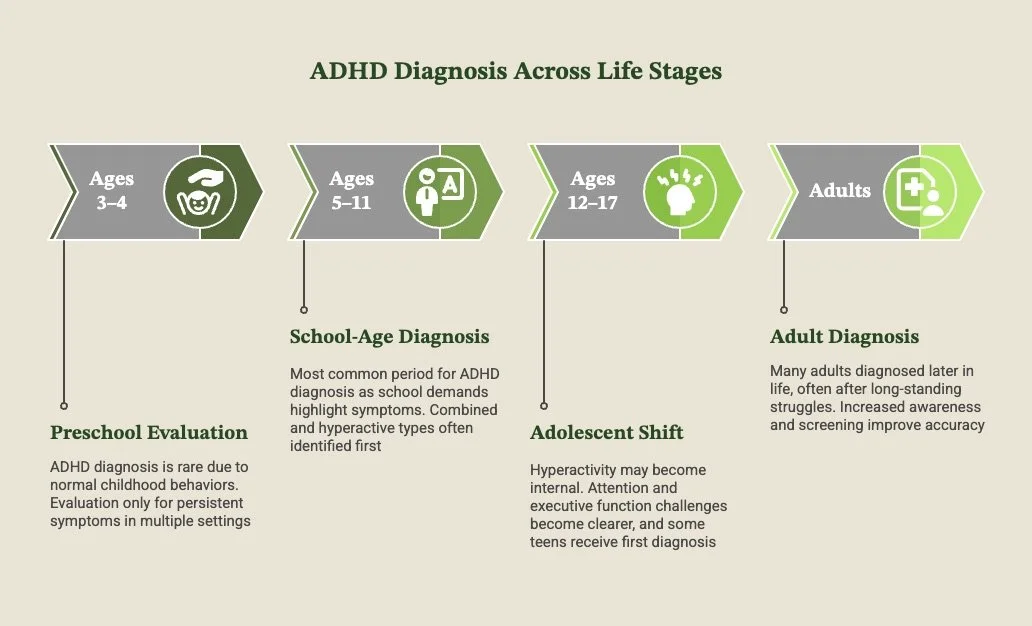
The answer to what age is ADHD diagnosed varies across different stages of life. Here’s how it typically unfolds.
Preschool Years (Ages 3–4)
Diagnosing ADHD this early is difficult because short attention spans and high activity levels are normal at this age. The American Academy of Pediatrics recommends evaluation only when symptoms are persistent and seen in multiple settings.
Early support often focuses on behavioral strategies and parent-guided interventions rather than medication.
Early School-Age (Ages 5–11)
This is the most common period for ADHD diagnosis. School introduces greater demands on focus, organization, and self-control, making symptoms more noticeable.
Most diagnoses occur around age 6–9.
Common patterns include:
Children with combined symptoms are often identified first
Hyperactive-impulsive kids are noticed early due to disruptive behavior
Inattentive children are diagnosed later because their symptoms are quieter
Adolescence (Ages 12–17)
ADHD can shift during the teen years. Hyperactivity may become more internal, while attention problems and executive function challenges become clearer as academic and social pressures increase.
Some teens receive their first diagnosis here, especially those who masked symptoms earlier or primarily show inattentive features.
Adults
Many adults are diagnosed later in life, sometimes never having been identified in childhood. Studies suggest around 6% of adults have ADHD, and more than half receive their diagnosis in adulthood.
This often happens after long-standing struggles with organization, emotional regulation, or work performance begin to make sense in hindsight.
Adult evaluations rely on documenting current symptoms and confirming they began in childhood, even if memories are unclear. Increased awareness and better screening tools have made adult diagnosis more common and more accurate.
How Early Signs Appear

Early signs of ADHD can show up in preschool, but identifying them takes care and context. Many young children naturally have short attention spans or high energy, so what matters most is persistence and impact.
Common early indicators include:
Inattention: Trouble staying focused during play or quiet activities, frequent daydreaming, and losing interest quickly.
Hyperactivity: Constant movement, running, or climbing at inappropriate times, difficulty staying seated during meals or group activities.
Impulsivity: Interrupting others, difficulty waiting for turns, acting before thinking.
In early school years, these patterns often become clearer. Academic tasks reveal challenges with following directions, organizing materials, and completing work without frequent redirection.
True ADHD signs show up across multiple settings, home, school, and social environments, and continue over time, not just in isolated moments.
How Is ADHD Diagnosed?

ADHD is diagnosed through a multi-step evaluation, not a single test. Clinicians look for patterns across time and gather information from different parts of a person’s life.
Clinicians typically review:
History: Medical, developmental, and behavioral patterns.
Input from others: Parents, teachers, caregivers, and self-reports when appropriate.
Rating scales: Age-appropriate behavior checklists.
Interviews: Conversations about symptoms and daily impact.
Differential diagnosis: Checking for conditions that overlap, such as anxiety, depression, learning issues, or sleep problems.
Observation and testing: Watching behavior and using attention or executive function tests when needed.
There is no single test for ADHD. Clinicians combine reports, interviews, and observed behavior to build an accurate picture.
Subtypes, Gender, and Diagnostic Timing

ADHD does not show up the same way in every person. Subtype and gender strongly influence when symptoms are noticed. These factors explain why some children get evaluated early while others are missed for years.
Combined Type: Often diagnosed earliest because symptoms are noticeable and disruptive. Concerns usually appear in the early school years. These children show both inattentive and hyperactive-impulsive traits.
Hyperactive-Impulsive Type: Typically identified in preschool or early elementary school. High activity levels and impulsive behavior are easy to spot. Caregivers and teachers often raise concerns early.
Inattentive Type: Frequently diagnosed later in childhood or adolescence. Symptoms can look like daydreaming or being “off-task,” which is often mistaken for low effort. Many are not referred until academic demands increase.
Gender Differences
Gender also affects how ADHD is recognized. Boys and girls often show different symptom patterns. These differences shape how quickly adults notice something is wrong.
Boys: Diagnosed more often because symptoms tend to be more outward and disruptive.
Girls: More likely to show quieter inattentive symptoms that do not cause classroom disruption.
Impact: These patterns lead many girls and women to be diagnosed much later in life.
Practical Guide and Resources

If you’re noticing signs of ADHD in yourself or someone you care about, seeking a professional evaluation is a strong next step. A thorough assessment helps you understand what’s going on beneath the surface and points you toward support that actually fits your needs.
Here are helpful steps to get started:
Observe if symptoms show up in more than one setting and genuinely affect daily life.
Write down when the behaviors began and how they impact school, work, or relationships.
Collect input from teachers, caregivers, partners, or supervisors to give clinicians a fuller picture.
Look for a clinician experienced in ADHD evaluations for the age group you're concerned about.
Expect a detailed process that may include questionnaires, interviews, and psychological testing.
Talk openly about any anxiety, depression, learning issues, or sleep problems that may overlap.
If a diagnosis is made, collaborate on a personalized treatment plan that fits daily life.
Find reputable ADHD organizations like CHADD or the American Academy of Pediatrics for guidance and community support.
Keep in mind that access to care varies, so advocating for a fair, thorough evaluation is important.
From Missed Signs to Next Steps With ADHD
Understanding what age is ADHD diagnosed can help explain why symptoms appeared early or only became clear later. Many people are diagnosed in adolescence or adulthood, especially when the signs were subtle or misunderstood.
A full evaluation looks at history, daily functioning, and patterns across settings to guide the right support. If you or your child is showing signs of ADHD, we’re here to help. Reach out today and begin getting the support and direction you deserve.
Frequently Asked Questions
At what age can ADHD be diagnosed?
ADHD can be diagnosed as early as age 4 when symptoms are persistent and impair functioning. However, diagnosis before this age is rare due to developmental variability. Most children receive a diagnosis between ages 6 and 9 when school demands reveal attention and behavior challenges more clearly.
Can ADHD be diagnosed in adults?
Yes, ADHD can be diagnosed in adulthood if symptoms have been present since childhood, as per DSM-5 criteria. Many adults are diagnosed later due to missed recognition earlier in life. Adult diagnosis involves evaluating current impairments along with childhood history, often through multi-informant reports.
Why is ADHD harder to diagnose in girls?
ADHD in girls often presents with inattentive symptoms that are less disruptive, making it harder to recognize. Social expectations and clinical biases also contribute, as diagnostic criteria were historically based on predominantly male samples. This results in delayed or missed diagnoses in many females.
What is the earliest age ADHD can be detected?
Signs of ADHD may be noticeable as early as age 3, but formal diagnosis is generally not recommended before age 4 due to overlap with typical toddler behavior. Persistent attention difficulties, impulsivity, and hyperactivity that impact daily functioning after age 4 warrant professional evaluation.
Does ADHD get better with age?
ADHD symptoms often evolve rather than disappear over time. Hyperactivity tends to decrease in adulthood, replaced by internal restlessness. Inattention and executive function challenges frequently persist. With appropriate treatment and support, many individuals lead successful lives despite ongoing symptoms.