Should I Get IQ Tested?
Struggling to understand why learning, problem-solving, or everyday tasks feel harder than expected can be frustrating and confusing.
When academic performance, work responsibilities, or daily routines consistently feel more difficult despite strong effort, it may raise questions about cognitive functioning.
These challenges can affect confidence, progress, performance, and everyday independence. Without clear answers, people may assume the problem is motivation or effort, even when underlying cognitive differences may be involved.
An intellectual functioning assessment evaluates reasoning, memory, processing speed, and problem-solving abilities to help clarify how someone learns, thinks, and manages daily demands.
Psychologists at Verdant Psychology specialize in cognitive and educational assessment, use standardized testing to identify patterns in intellectual functioning and provide clearer insight into these experiences.
What is an IQ test?

An IQ test is a standardized tool used in an intellectual functioning assessment to measure cognitive abilities such as reasoning, memory, vocabulary, and pattern recognition.
These tests are administered by psychologists using structured tasks and problem-solving activities designed to evaluate how a person processes information.
Unlike online quizzes, a formal intellectual functioning assessment provides a detailed view of different thinking abilities, not just a single score. Results are usually grouped into areas such as verbal comprehension, visual reasoning, working memory, and processing speed.
IQ scores are standardized with an average of 100, and most individuals score between 85 and 115.
Common assessments include the Wechsler Adult Intelligence Scale (WAIS-IV) for adults and the Wechsler Intelligence Scale for Children (WISC-V) for children.
These tests help identify patterns in cognitive strengths and challenges that may influence learning, problem-solving, and everyday functioning.
5 common reasons people get IQ tested
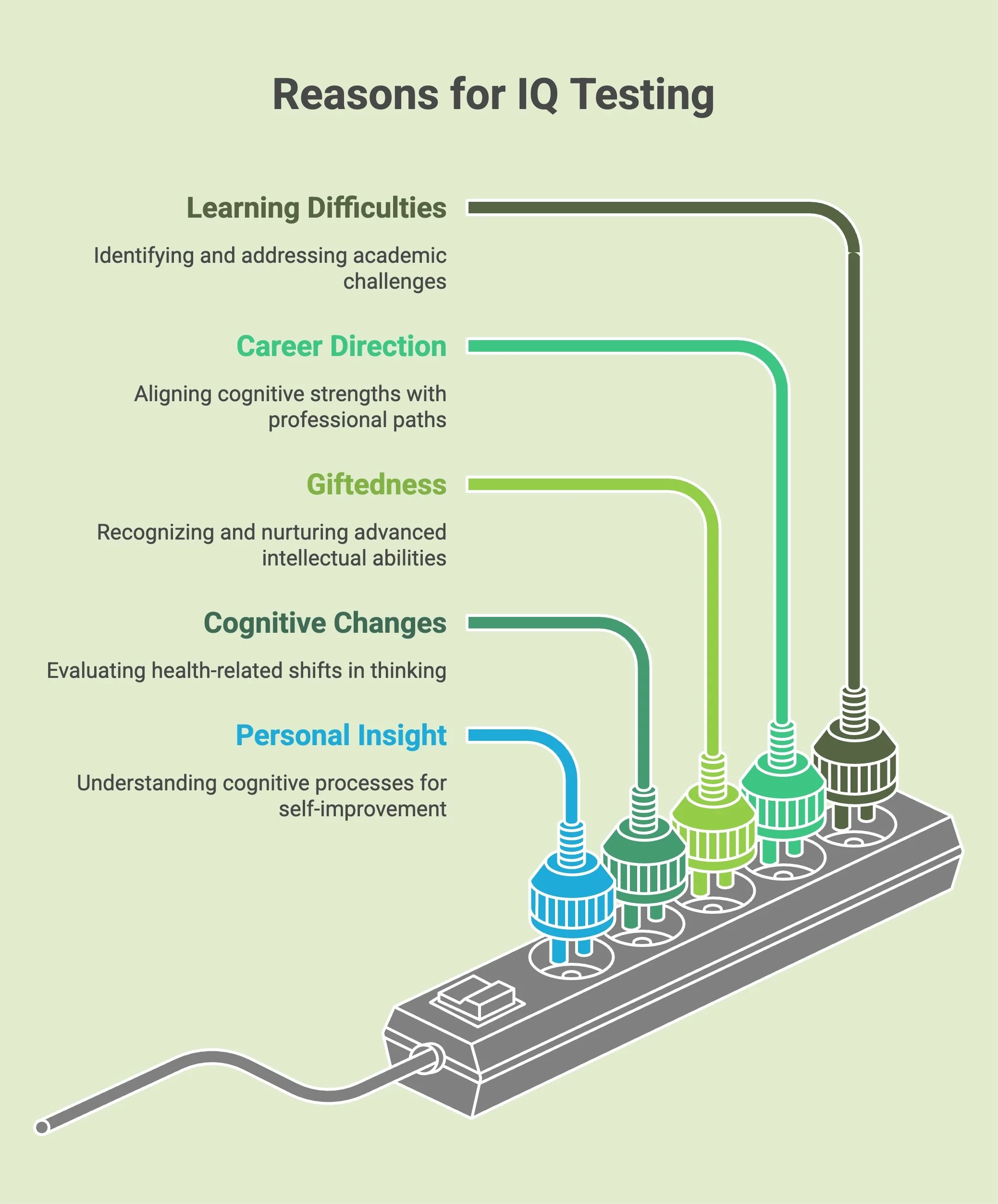
People get IQ tested to understand learning difficulties, identify cognitive strengths, evaluate changes in thinking abilities, guide career decisions, or gain personal insight through an intellectual functioning assessment.
Looking at a few common situations can help understand when IQ testing may be useful.
School or learning difficulties
IQ testing can help identify learning differences when academic performance does not match effort or expectations. An intellectual functioning assessment can reveal patterns related to attention difficulties, learning disorders, or processing challenges.
These results can help guide accommodations such as extra time on exams or specialized educational support.
Career direction
Some individuals pursue IQ testing to better understand cognitive strengths that may influence career choices. Intellectual functioning assessments can highlight abilities related to reasoning, problem-solving, language, or analytical thinking that may align with certain professional paths.
Giftedness or advanced learning
IQ testing is often used to evaluate if someone may meet the criteria for gifted programs or advanced academic placement. In some cases, individuals may show both high intellectual ability and learning challenges, a pattern sometimes described as twice-exceptional.
Cognitive changes related to health
An intellectual functioning assessment may also be recommended when someone notices changes in memory, concentration, or thinking abilities.
Testing can help establish a cognitive baseline and assist clinicians in evaluating how health conditions, stress, or neurological factors may be affecting cognitive functioning.
Personal insight and self-understanding
Some people seek IQ testing out of curiosity or a desire to better understand how they process information. Learning more about cognitive strengths and challenges can help individuals develop strategies that support learning, productivity, and everyday problem-solving.
When to get IQ tested?

IQ testing is recommended when ongoing patterns in learning, problem-solving, memory, or daily functioning suggest a need to better understand cognitive strengths or challenges.
Signs that may suggest IQ testing
Some patterns may indicate that an intellectual functioning assessment could be helpful. These often appear as ongoing challenges rather than isolated situations:
Academic or work performance falling behind expectations despite consistent effort
Frequent forgetfulness during daily routines or tasks
Feeling cognitively different from peers, family members, or coworkers
Difficulty managing practical skills such as budgeting, planning, or organisation
Challenges understanding social cues or communication patterns
Age and life stages
IQ testing can be helpful during periods when learning, work, or daily responsibilities begin raising questions about cognitive strengths or challenges. For children, testing is often recommended around ages 6–8, when cognitive abilities become more stable, and school demands increase.
For adults, an assessment may be useful during major life transitions, ongoing work difficulties, or when concerns about memory, reasoning, or learning patterns begin affecting daily functioning.
Adaptive skill patterns that may signal a need for assessment
Some signs relate to adaptive functioning, which refers to practical skills used in everyday life:
Difficulty managing money or handling financial responsibilities
Challenges in interpreting social situations or communication cues
Problems keeping up with planning, scheduling, or organization
Should I get IQ tested?

IQ testing may be beneficial if it helps provide understanding, guidance, or support. An intellectual functioning assessment can offer insight into how someone thinks and learns, helping guide educational planning, career decisions, or access to appropriate support.
However, IQ scores should be interpreted carefully. A score cannot capture qualities such as motivation, creativity, or emotional insight, and results are most meaningful when reviewed within a broader psychological evaluation with a qualified clinician or psychologist.
Get clarity with Verdant Psychology
Clear insight into cognitive strengths and challenges can guide decisions about learning, work, and everyday functioning. An intellectual functioning assessment explains how someone processes information and can highlight patterns that influence focus, problem-solving, and learning strategies.
Verdant Psychology provides supportive intellectual functioning assessments using established cognitive testing methods and personalized feedback to help individuals better interpret their cognitive profile.
If you would like clearer insight into your thinking and learning patterns, book a free consultation to discuss if an intellectual functioning assessment may be helpful for you.
Frequently asked questions
How Long Does an IQ Test Take?
Most IQ tests take 60–90 minutes. The assessment includes tasks measuring reasoning, memory, language, and processing speed, followed by professional interpretation of the results.
What does an IQ Test measure?
An IQ test measures cognitive abilities such as reasoning, memory, verbal understanding, and processing speed. Results show how someone processes information rather than defining overall intelligence.
Can IQ scores change over time?
IQ scores are generally stable but can shift slightly due to education, development, health, or life experiences. Psychologists interpret results alongside learning history and real-life functioning.
Are online IQ tests accurate?
Online IQ tests can be accurate if they are administered and interpreted by a licensed psychologist using standardized assessment tools. However, most online quizzes are not clinical evaluations and do not follow the proper testing procedures required for a valid intellectual functioning assessment.
Who should you consider getting an IQ test?
IQ testing may help individuals with learning difficulties, unexplained academic challenges, or questions about cognitive strengths. A psychologist can determine whether an intellectual functioning assessment is appropriate.