Why Cognitive Skills Evaluation Is Important for Autism Testing
Do you need a cognitive skills evaluation for autism testing? Cognitive testing is included in autism evaluations, but its purpose is not always clear.
Cognitive testing helps evaluate how a person thinks, learns, solves problems, and processes information. While it cannot diagnose autism alone, it can provide valuable insight into cognitive strengths, challenges, and support needs.
Let's take a closer look at why cognitive testing is included in autism evaluations.
What is a cognitive skills evaluation in Autism testing?

A cognitive skills evaluation in autism testing measures abilities such as reasoning, memory, processing speed, attention, language, and problem-solving.
Individuals with autism often show unique cognitive profiles. Through cognitive testing, clinicians can identify these patterns by using standardized tasks that measure skills such as reasoning, memory, attention, processing speed, and problem-solving.
Performance across these areas can help reveal cognitive strengths and challenges that may affect daily functioning.
Why cognitive skills evaluation is important for Autism testing
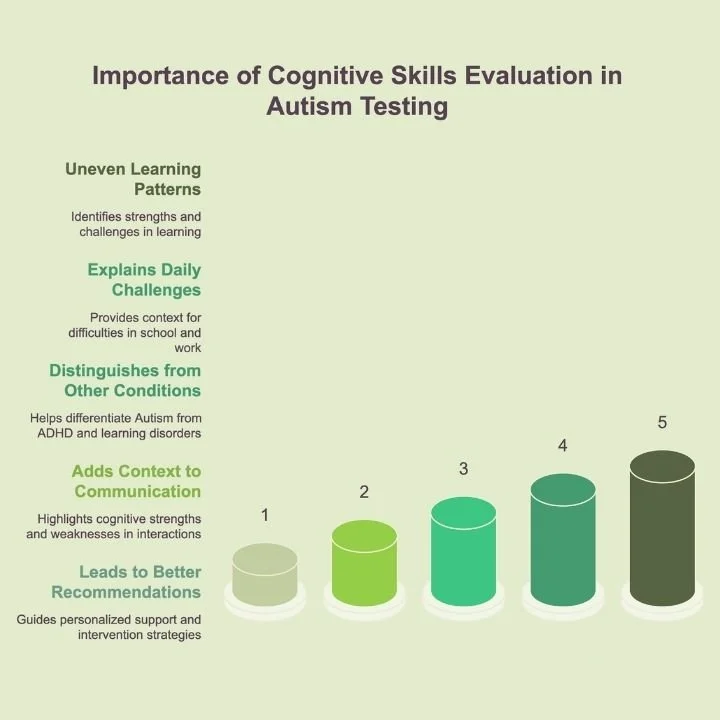
Cognitive skills evaluation provides valuable insight into how a person thinks, learns, solves problems, and adapts to everyday situations.
1. Cognitive testing shows uneven learning and thinking patterns
Autism often affects cognitive skills unevenly, with strengths in some areas and challenges in others. Identifying these patterns is important because it provides a clearer understanding of how an individual learns, solves problems, and navigates everyday demands.
2. Cognitive results help explain school, work, and daily-life challenges
Cognitive results can help explain difficulties with organization, following instructions, completing tasks, managing time, or adapting to change. These findings provide valuable context for challenges that may occur in school, work, and everyday life.
3. Cognitive testing helps separate Autism from other concerns
Autism can overlap symptoms with ADHD, learning disorders, language disorders, and other conditions. Cognitive testing provides objective information that helps clinicians distinguish between these conditions and make more accurate diagnostic decisions.
4. Cognitive scores add context to communication and behavior
Cognitive scores can highlight strengths in some areas alongside challenges in others. A person may demonstrate strong reasoning skills but lower scores in working memory or language processing. These differences can provide important context for communication, social interactions, and everyday functioning.
5. Cognitive findings lead to better recommendations
The findings help guide recommendations for school accommodations, workplace supports, therapy services, and skill-building strategies. This information can help identify supports and interventions that align with an individual's cognitive profile and daily needs.
How cognitive and adaptive testing guides Autism support

Cognitive and adaptive testing guides autism support by examining both thinking abilities and real-world functioning.
Cognitive testingmeasures skills such as reasoning, memory, and problem-solving. Adaptive testing focuses on everyday skills, including communication, social functioning, self-care, and independence.
Reviewing both sets of results together can help identify strengths, areas of difficulty, and situations where additional resources, accommodations, or interventions may be beneficial.
Get clarity from autism testing at Verdant Psychology
Some questions cannot be answered through observation alone. Cognitive testing can provide additional insight that helps guide recommendations, accommodations, and future planning.
For individuals and families seeking greater clarity, a comprehensive autism evaluation can provide information that supports more informed decisions moving forward.
Book a Free Consultation with Verdant Psychology to know your testing options.
Frequently asked questions
Do I need a cognitive assessment for autism testing?
Not always, but it is often helpful. Cognitive testing can reveal learning patterns, academic needs, and thinking skills that may not be apparent through interviews and behavioral observations alone.
What is a cognitive assessment for autism?
A cognitive assessment is a structured evaluation of how a person thinks, learns, and solves problems. It typically includes tasks that measure reasoning, memory, attention, language, and processing skills.
What cognitive skills are assessed during autism testing?
Commonly assessed skills include verbal reasoning, visual-spatial abilities, working memory, processing speed, attention, and executive functioning. The specific areas evaluated depend on the individual's age, concerns, and referral questions.
What does adaptive skills testing measure in an autism evaluation?
Adaptive skills testing measures how a person handles everyday responsibilities. Areas often assessed include communication, social skills, self-care, organization, decision-making, and independent living abilities.
Can cognitive testing diagnose autism by itself?
Cognitive testing is only one part of a comprehensive autism evaluation. Clinicians also consider developmental history, behavioral observations, interviews, and autism-specific assessment measures when making diagnostic decisions.