The latest research on Dyslexia is reshaping how diagnosis works, replacing delayed, failure-based models with earlier and more accurate identification. Instead of waiting for years of academic struggle, new findings show neurological and cognitive patterns that can be recognized much sooner.
These shifts matter because late diagnosis often leads to mislabeling, reduced confidence, and missed support during critical learning years. Evidence now shows Dyslexia reflects a specific learning profile, not low intelligence or lack of effort.
By integrating emerging science with real-world evaluation experience, this guide explains how Dyslexia diagnosis has changed, what professionals now assess, and why evidence-based testing leads to better outcomes over time.
Neuroscience Breakthroughs in Dyslexic Thinking
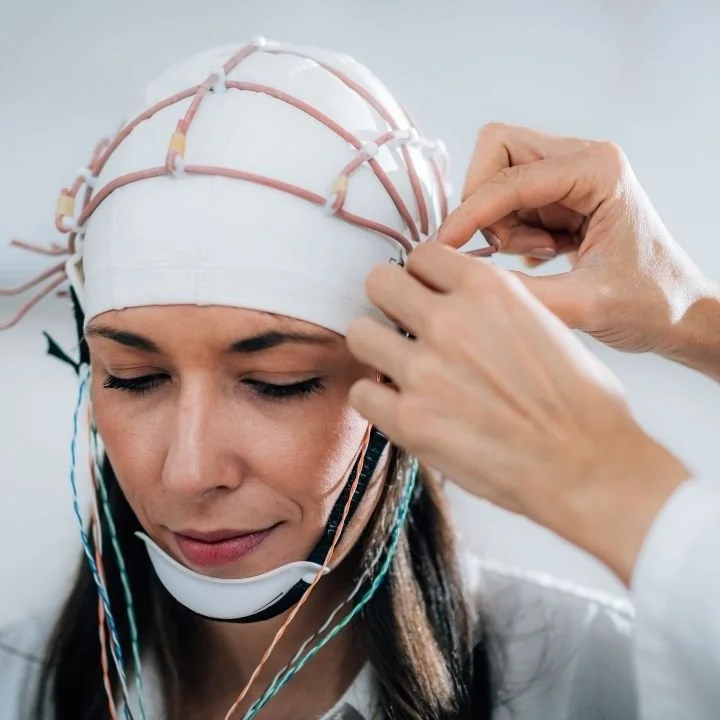
Recent neuroimaging has shifted how Dyslexia is understood at the brain level. Using tools like fMRI and EEG, researchers can now see how the dyslexic brain processes information differently. These scans show lower activity in the left temporo-parietal region, the area used for phonological decoding, or sounding out words. This helps explain why reading and spelling can feel slow or effortful.
At the same time, other brain networks are more active. Areas linked to visuospatial processing, pattern recognition, and big-picture thinking often work more efficiently. In research tasks, people with Dyslexia solved visual puzzles and mental rotation problems up to 30 percent faster than those without it. These strengths matter in real careers like engineering, architecture, design, and technology.
These patterns appear in both children and adults. Long-term studies show that when visuospatial strengths are supported early, people build stronger confidence, lower anxiety, and better problem-solving skills over time.
This research helps families understand that Dyslexia reflects a different learning profile, not a lack of ability.
Genetic Overlap and Neurodevelopmental Clustering
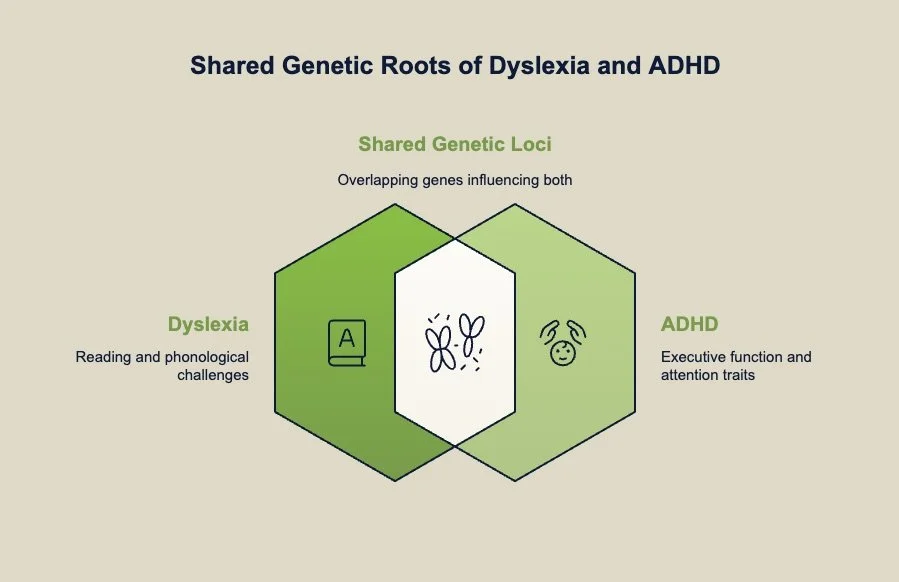
Recent genetic studies are showing that Dyslexia rarely exists on its own. Large Genome-Wide Association studies from 2024 and 2025 found shared genetic markers between Dyslexia and ADHD.
Researchers identified 49 overlapping genetic loci, supporting the idea that these conditions are part of a broader neurodevelopmental cluster rather than separate disorders. This helps explain why about 40 percent of people with Dyslexia also show ADHD traits.
Some of the genes involved, such as ROBO1, play a role in how the brain develops before birth. These genes can affect phonological processing, which impacts reading, while also influencing executive functions like adaptability, problem-solving, and risk-taking.
In simple terms, the same genetic factors linked to reading challenges can also support strengths in flexible thinking and creativity.
This research is changing how diagnosis works. Instead of looking at Dyslexia or ADHD in isolation, clinicians increasingly screen for both together. New tools like polygenic risk scores, which use small saliva samples, can help identify children who may benefit from early support.
IDA’s Definition Update and Early Identification

In October 2025, the International Dyslexia Association updated how Dyslexia is defined and diagnosed. The old model required a gap between IQ and reading scores, which often delayed support for years. The new definition focuses on ongoing reading and spelling difficulties that are unexpected and not explained by intelligence or poor instruction.
This change allows identification much earlier. Instead of waiting for failure, screening can begin around age five using tools like CTOPP-2 and AI-based eye-tracking. Early identification makes it easier to provide structured reading support before frustration and academic gaps grow.
The updated model also recognizes different levels of difficulty and includes strengths as part of the assessment. When early screening is paired with structured literacy and supportive technology, many children make strong reading gains by elementary school.
The $4.5 Trillion Economic Impact of Dyslexic Thinking

Recent findings from Made By Dyslexia and Randstad show that dyslexic thinking already contributes about $4.5 trillion to the global economy each year. Most of that value remains untapped. Only around 30% of dyslexic employees feel supported enough to use their strengths at work.
The impact is especially clear in innovation-driven roles. Dyslexic individuals are overrepresented among entrepreneurs and self-made leaders, far exceeding their share of the population. A 2025 study in Singapore found that more than a quarter of startup founders identified as dyslexic, crediting strong pattern recognition and market insight.
These numbers change how diagnosis is viewed. Early identification helps connect strengths to the right environments sooner. When workplaces reduce unnecessary administrative demands and focus on problem-solving and big-picture thinking, productivity rises. In an AI-driven economy, these abilities carry increasing value.
From Evidence to Earlier Answers
The latest research on Dyslexia shows a clear shift away from delayed, failure-based diagnosis and toward earlier, more accurate identification grounded in brain science, genetics, and real-world outcomes.
Dyslexia is now understood as a distinct learning profile with measurable strengths, not a deficit in intelligence or effort. Earlier screening and evidence-based evaluation allow support to begin when it matters most.
When diagnosis reflects how people actually learn and think, outcomes improve across school, work, and life. The goal is no longer to catch up after years of struggle, but to recognize patterns early and align support with strengths from the start.
If you have questions about evaluation or next steps, schedule a free consultation to talk through options with a qualified professional.
Frequently Asked Questions
Is Dyslexia a form of neurodivergence?
Yes, Dyslexia is neurodivergence like ADHD and autism, protected under 2025 US/UK laws. It features phonological challenges with visuospatial strengths, driving innovation in 20% of people. Early AI screening nurtures these talents compassionately.
Can you develop Dyslexia as an adult?
Dyslexia is developmental from childhood genetics. Acquired alexia from injury differs, lacking visuospatial edges. Adults use phonological tests for clarity and accommodations like text-to-speech to thrive professionally.
Does Dyslexia affect IQ?
2025 IDA definitions drop IQ gaps, focusing on unexpected phonological issues. Dyslexics excel across IQs in spatial skills, powering 20-40% of entrepreneurs and $4.5T economic value when supported.
What is the best font for Dyslexia?
Letter spacing and line height beat Dyslexie fonts, cutting visual crowding by 25% per 2025 studies. Pair with sans-serif options and tools like Read&Write for fluency gains in reading support.
How early can Dyslexia be diagnosed?
Age 5 via AI eye-tracking and CTOPP-2 tests, per IDA 2025 model, catching 95% cases pre-"wait-to-fail." This prevents prison pipelines (50% rate) and unlocks dyslexic potential early.